
Your AI agents are waiting on you: lessons from Anthropic's internal data
Anthropic's agents log six hours per human hour and sit idle 80% waiting on humans. What its employment report means for agent builders.
You probably already know the feeling. Two or three coding agents run in parallel, they all finish within minutes of each other, and you spend the next hour reading diffs and answering questions they should have been able to answer themselves. Anthropic just published a report on what this looks like at company scale, with agent telemetry and hiring records to match. The headline in most coverage was junior hiring falling from 27% to 9% of technical hires. The useful part for builders is a different number.
The constraint flipped
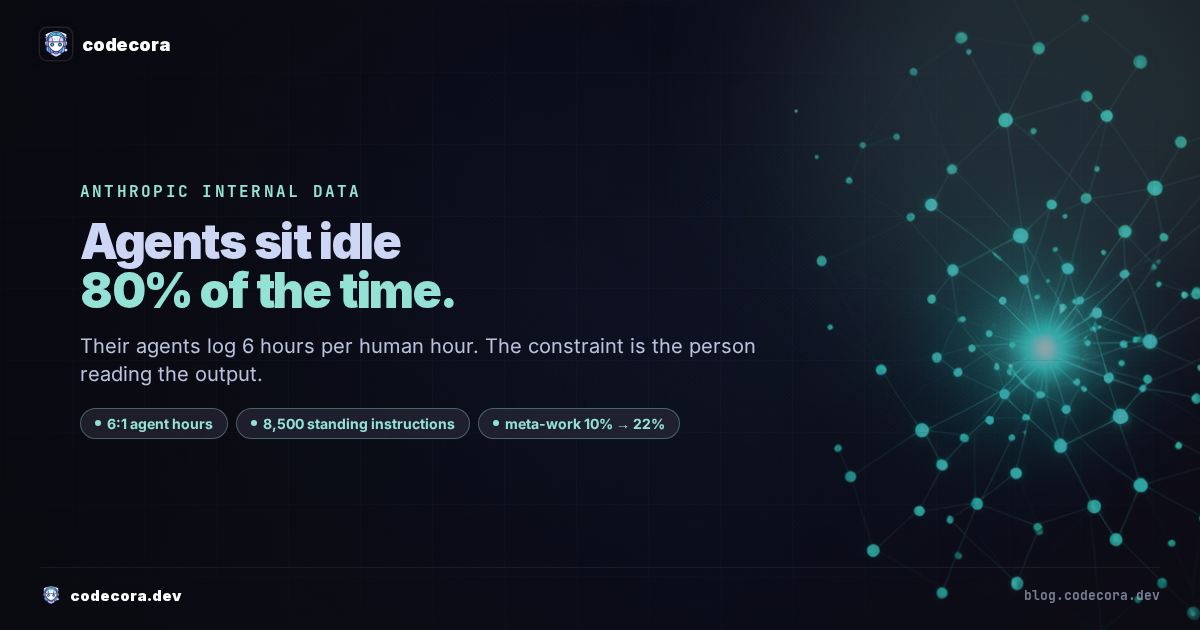
By March 2026, agent work hours at Anthropic passed human work hours. By August, employee-directed agents were logging six hours for every employee hour. And in interactive sessions, those agents sat idle about 80% of the time. Idle means waiting: for a review, a decision, a credential, a reply in a terminal. The agents are not the constraint. The humans reading their output are.
The report puts a number on the reading too. Convert agent output to words (the researchers assume 0.75 words per token and 250 words a minute) and employees in non-technical roles receive enough agent output to eat more than half their work week, if they read all of it. Nobody does. The median employee also spends 20% more time in meetings than a year ago, up 16% even among technical individual contributors. Coordination with other humans did not shrink. It grew alongside the agent fleet.
What employees actually built
Meta-work, meaning sessions spent managing agents rather than doing the job itself, rose from 10% of interactive sessions in fall 2025 to 22% by spring 2026. Most of the increase is agent management: writing specs for multi-agent runs, pointing one agent at another's output for review, and building dashboards to monitor agent pipelines.
Written standing instructions tell the same story: a few hundred in July 2025, 8,500 a year later. That is the pattern to copy early. Every recurring correction you type twice should become a standing instruction, a spec template, or a reviewer-agent check. Anthropic employees did this reactively at company scale. You can do it deliberately at yours.
One employee wrote a performance review for their Claude team ("let's talk about what is and is not working about our communication style"). A lawyer stopped reviewing legal questions and started writing frameworks so that client-side agents could discover correct legal reasoning, described in the report as doing SEO for legal advice. When software reads most documents first, you write for the software.
Did quality hold up?
Faster output means little if it is slop. The researchers compared code committed by an employee against code committed by that same employee's agent, same month, same directory. No difference in lines later deleted, reverted, or flagged. The adopter study (192 engineers who adopted coding agents against 74 who did not, tracked over time) shows output rising sharply in the months after adoption.
The report also names its biggest weakness plainly: adoption was not random, and engineers who moved to fully autonomous agents were already on a rising trajectory before the switch. That honesty is rare in corporate self-studies. Read the finding as "output rose with adoption inside Anthropic," not as a universal multiplier. And note what the report does not claim: more commits is not more value, and the authors cite NBER work on exactly that gap.
The parts that did not automate
Agents appeared in nearly half of Anthropic's active public Slack channels, yet the structure of human communication barely changed. Agents joined as team members for individual employees, not as hubs. Face-to-face coordination stayed indispensable, and decisions made outside logged channels actively hurt: one employee's name stayed on a months-old swag document, so agents kept routing t-shirt requests long after the role changed. Private decisions are invisible to your agents, and invisible context produces stale output. If your team makes decisions in unlogged meetings or DMs, your agents are reasoning from last week's state.
Takeaways for agent builders
Treat review throughput as your real capacity metric. You are the 80% idle time.
Move recurring corrections into standing instructions and specs. The 8,500 figure took a year to reach; start before you need it.
Use agents to check agents. A reviewer pass on another agent's output is the cheapest filter you can build against the reading flood.
Keep decisions in logged, searchable channels. Your agents are only as current as the context they can see.
Do not copy the hiring conclusion blindly. The junior-hire decline is real, but it comes from one frontier company whose staff have the earliest access to the strongest models. The report itself says generalizing is not straightforward.
It closes on an expectation gap: 91% of Anthropic staff expect AI to make a Nobel-level discovery by 2030, against 39% of the US public. People believe what their tools show them. If your agents show you a working pipeline and a full queue of decisions, the pipeline is real. So is the queue.