
Rungu: The Self-Hosted Alternative to Subscription Changelog and Roadmap Widgets
A feedback board, roadmap, and changelog in one self-hosted binary. What $29/month SaaS pricing does not include: your data, on your server.
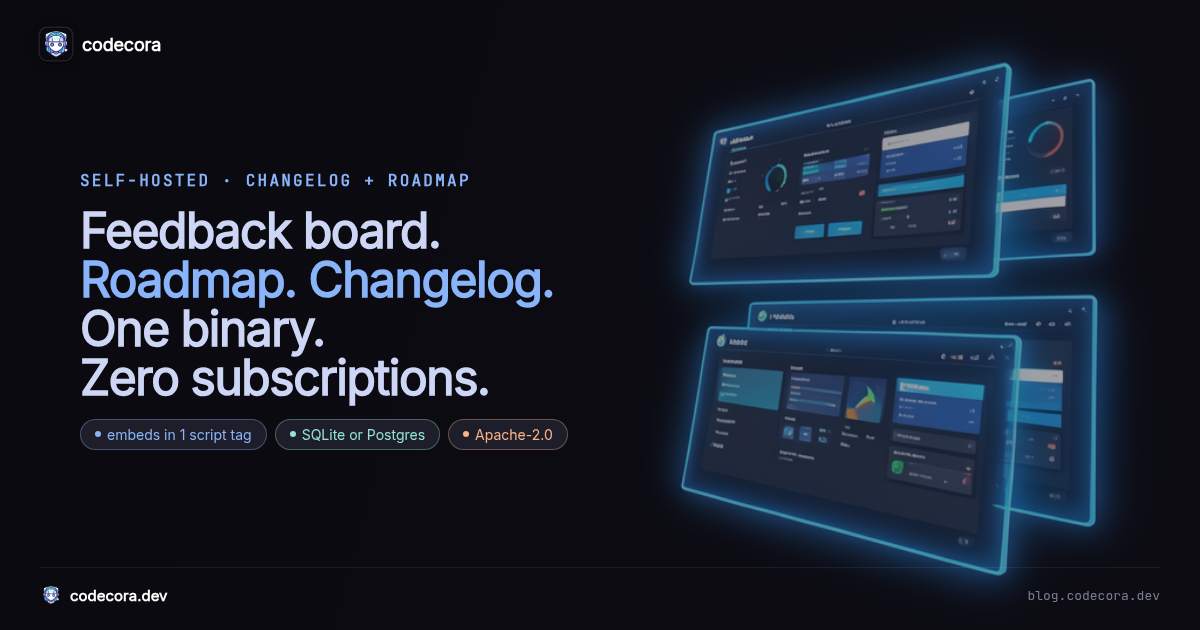
Roadmap software is having a quiet pricing moment. UserJot charges $29 a month for its Starter plan and $59 for Professional. Headway wants $29 a month for Pro. Featurebase has moved upmarket into helpdesk, and its paid tiers bill per seat plus $0.49 per AI resolution. None of these numbers are unreasonable for what these tools do. But there is a structural detail underneath all three pricing pages: your feedback board, your public roadmap, and your changelog live on someone else's servers, billed monthly, forever.
This post is about the other option. Rungu is a self-hosted feedback board that ships the same three surfaces as one Rust binary: a voting board for feature requests, a roadmap view, and a changelog view, plus a script tag that embeds all of it into your own site. Your database, your domain, no monthly invoice.
A note on scale before the comparisons: Rungu has 9 stars on GitHub and shipped its latest release on September 8, 2026. It is young. The vendors in the comparison table have years of polish. If you want hosted convenience with a mature ecosystem, the paid tools are genuinely good, and the section at the end says exactly where they win.
Three surfaces, one deployment
Most products end up needing the same trio. A board where users can post feature requests and upvote each other's. A public roadmap showing what is planned, in progress, and done. A changelog telling the same users what shipped. SaaS tooling splits this trio across plan tiers: UserJot gates private boards and custom domains behind Starter, Featurebase gates multilingual support and SLAs behind Professional, and the monthly bill grows with every feature you add.
Rungu ships all three views as tabs in the public board interface. The v0.6.0 release (September 8, 2026) moved Feedback, Roadmap, and Changelog into a single tab row under the board title, with status workflow states (open, planned, in progress, done) driving the roadmap. One deployment serves all three surfaces, and the status workflow is what turns a board post into a roadmap entry without any data leaving your server.
The embed widget
Since v0.3.0, embedding is one script tag:
<script src="https://feedback.example.com/embed.js" data-board="my-board"></script>
The loader is vanilla JavaScript with no build step and no npm install on the host page. It drops an iframe onto the page and auto-resizes it via postMessage, so the board grows with its content. Your users post feedback without ever noticing they have left your site. A data-theme attribute matches your site's light or dark mode.
For teams that care about branding, v0.4.0 added white-labeling: environment variables rebrand the header, page titles, and the embed board itself. The "Powered by Rungu" badge comes off with a license key ($49 per major version or $70 lifetime, via Polar). That is the only paid element in the product, it is a one-time number rather than a monthly one, and an expired license only brings the badge back. The board itself is never throttled.
How it runs
The whole stack compiles to a single binary with the admin interface embedded. SQLite is the default database, configured through a volume mount; PostgreSQL is available via DATABASE_URL when you outgrow it. Multi-provider auth (Google, GitHub, Keycloak) is env-driven, and users with the same email across providers merge into one identity. Full-text search across posts runs on SQLite FTS5, on your hardware.
The honest comparison
| UserJot | Headway | Featurebase | Rungu (self-hosted) | |
|---|---|---|---|---|
| Pricing model | $29 Starter, $59 Pro /mo | $29 Pro /mo | per seat + $0.49 per AI resolution | $0 (badge removal $49-$70 one-time) |
| Feedback board with voting | Yes | widget badge, not a board | Yes | Yes |
| Public roadmap | Yes | limited | Yes | Yes (status workflow) |
| Changelog view | Yes | Yes (core focus) | Yes | Yes (tab) |
| Embed widget | Yes | Yes | Yes | Yes (1 script tag) |
| Self-hosted | No | No | No | Yes |
| Data location | Vendor cloud | Vendor cloud | Vendor cloud (EU) | Your server |
Pricing and feature rows for the hosted tools were verified against their public pricing pages on September 29, 2026. Featurebase's changelog and roadmap ship inside a broader support suite, and the pricing page notes feedback features are included in the same subscription. Headway is the changelog specialist of the three; its roadmap surface is a widget badge, not a board.
What the table cannot show is maturity. Featurebase has thousands of customers, SOC 2 badges, and a startup program. UserJot and Headway have years of iteration on their workflows. Rungu has nine stars and five releases in three weeks of velocity. If your team wants someone else to handle uptime, updates, and edge cases, pay the $29. Renting that peace of mind is a legitimate choice.
Where self-hosting changes the decision
Three situations flip the calculus:
First, the data. A feedback board accumulates your users' product wishes, contact identities, and internal prioritization notes. On a hosted tool, that corpus sits behind someone else's terms of service and export tools. Self-hosted, it is a SQLite file you back up with everything else.
Second, the compound cost. $29 a month is $348 a year per tool, and the trio rarely comes from one vendor. A changelog here, a roadmap there, and the annual total passes a full-time server's cost. The self-hosted stack costs the VPS you already run.
Third, the feedback loop itself. Rungu ships an MCP server (26 tools for AI coding agents like Claude Code, Cursor, and Windsurf) and a full REST API with webhooks. An agent can read the board, triage posts by category, draft roadmap statuses, and post changelog entries when releases ship. Your feedback data becomes input for your own automation instead of rows in someone else's dashboard. The earlier post on running AI agents against a Rungu board covers this pattern.
Run it yourself
The repository is codecoradev/rungu on GitHub, Apache-2.0 licensed, and the published image is multi-arch on GHCR. This is the full run command, mirroring the Docker Compose file in the repository:
docker run -d --name rungu -p 3000:3000 -v rungu-data:/data -e APP_SECRET=pick-a-long-random-string ghcr.io/codecoradev/rungu:latest serve --db /data/rungu.db --listen 0.0.0.0:3000
Open http://localhost:3000, then add your first project with docker exec rungu /rungu project-add "My App" --slug myapp. Prefer Compose? The repository ships a docker-compose.yml with the same volume, port, and health check wired up: docker compose up -d (set APP_SECRET first). The quick start, CLI reference, and the 689-line production deployment guide covering Traefik, Let's Encrypt TLS, and backups live at rungu.pages.dev. The screenshots in this post come from the project's own documentation.